
Get Early Access to Residency Interview Prep Coaching | Med School Performance Coaching Enrollment Open Now

The purpose of your MyERAS Application (often called the ERAS CV) is to highlight your experiences in a way that’s attractive to programs.
This isn’t achieved through an endless series of bullet points or short, 1st person paragraphs. Instead, you’ll need to craft detailed, impactful, and strategic entries. To do so, we’ll consider the ERAS CV from a rhetorical perspective grounded in audience analysis (i.e., how program directors read).
Below, we’ll explain the main components of the MyERAS Application along with best practices. They may go against advice you’ve read elsewhere, but they are all backed by years of experience–and successful matches!
Before we dive in…did you know applicants cannot upload PDF CVs into the ERAS system?
Instead, you’ll fill in a series of fields within ERAS, adding details for each experience (dates, location, title, responsibilities, etc.). The output is a document that’s uniform in formatting for everyone, making it easy for programs to evaluate.
Take a moment and think about the last part of the previous sentence: make it easy for programs to evaluate your CV. To get it right, we can look toward research about the way people read.
A series of studies by Dr. Ziming Liu and others discovered that the majority of readers rely on skimming when they first encounter a piece of writing. Think about it…when you have to read something, is your first instinct to read straight through? Or do you skim/scroll a bit through the document to “get a feel” for what’s to come–and whether or not you want to continue reading?
When we skim, our brains are actively trying to identify key pieces of information.
Poor formatting, overly complex phrasing, and “walls” of text make it difficult to do this. And when something you have to do is unnecessarily difficult, you enjoy it less.
Submitting a CV that’s difficult to skim is likely to annoy program directors, who will then review your CV in a less-than-ideal mind frame. At worst, they’ll decide your CV isn’t interesting enough to bother reading it more closely.
Keep in mind these decisions aren’t calculated, it’s just how the brain processes text.
Now that we’ve established a framework for how your CV is likely to be read, here are best practices you can rely on to build an easy-to-read CV.
There aren’t a lot of formatting options for this section of ERAS.
Nonetheless, you can take advantage of white space, headers, and bullet points to ensure a smooth reading experience.
Take a look at these 2 experience descriptions:
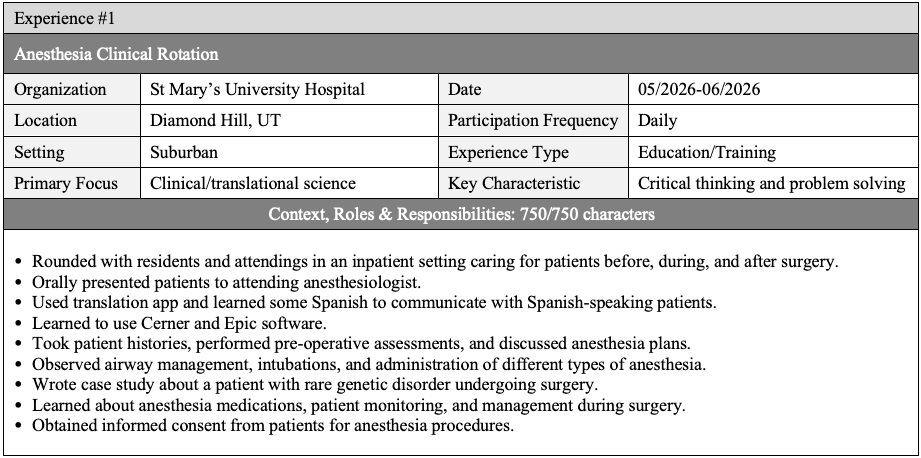
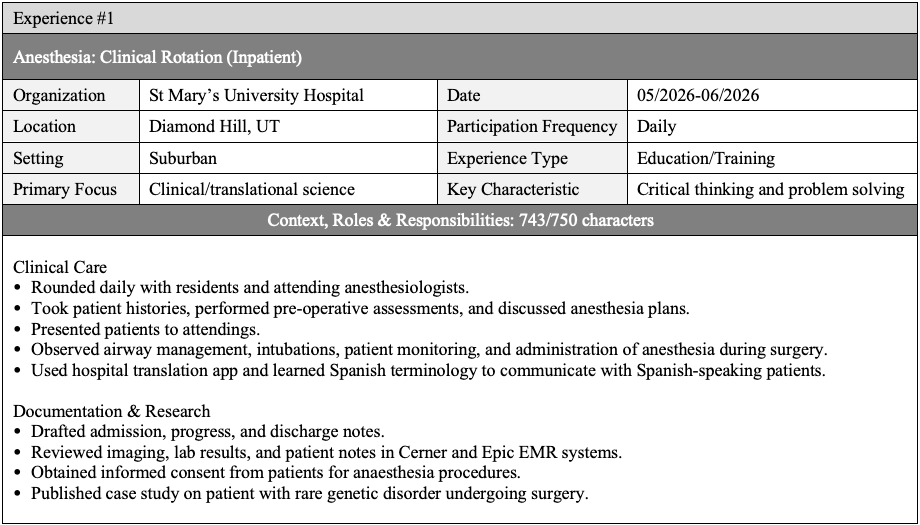
The first example requires a slower reading to ascertain what’s being conveyed.
The second example is easy to skim and assess.
We do NOT recommend using 1st-person, narrative paragraphs in the CV. They are even harder to skim than a list of bullets:
NO: During this experience, I built rapport with patients while taking histories and performing physical exams. I also presented cases to attendings during morning rounds and cared for patients with multiple co-morbidities, which helped me gain experience with EPIC EMR. My role included seeing new and established patients for whom I suggested reasonable differential diagnoses, gathered data, and made every effort to find definitive diagnoses.
Additionally, I planned patient care and observed cases of hemophilia, sickle cell anemia, and various other diseases. I presented on 3 topics: palliative care, hospice care, and sickle cell anemia. Finally, I assisted in blood transfusions, vaccinations, biopsies, and other activities.
When it comes to creating bullet points, aim for concrete word choices and straightforward phrasing. This maximizes readability and impact.
Here are a few examples:
USMLE Peer Tutor
Hands-on Internship
Vice President: Student Interest Group
In this section, you’ll consider your 10 experiences and select 3 of them as “most meaningful.” These will be the first 3 experiences presented on your CV—so your choices are quite important.
The biggest mistake applicants make here is writing entries discussing what they learned or did. The ERAS instructions for this section are clear: “The [meaningful experiences] should not describe what you did in the experience or list a set of skills that you developed or demonstrated.” Instead, write your meaningful experience sections based on how the experience made you feel, how it influenced your path, and/or the impact it had on your values.
Ineffective meaningful experience entry: I learned how to triage incoming patients and pay attention to non-verbal cues. Additionally, working alongside a multidisciplinary team strengthened my communication skills.
Effective meaningful experience entry: Encountering undereducated and uninsured patients was a poignant reminder of the disparities in healthcare. It prompted me to authentically engage with patients and their families and instilled a deep sense of empathy.
The supplemental information sections in the MyERAS Application emerged from a separate “Supplemental Application” document. It was tested across a number of specialties for 2 match cycles (2021 & 2022), and the feedback was positive. Now, the best elements from the Supplemental Application are embedded in the main application, and research and AAMC data confirms they are important to programs.
The geographic preference section offers three options:
Data suggests that geographic preferences should be approached differently depending on specialty.
In family medicine, internal medicine, interventional radiology, anesthesiology, psychiatry, neurology, pediatrics, diagnostic radiology, general surgery, and pathology, applicants are more likely to receive interviews when they select 3 geographic preferences, even when some of the programs they applied to fell outside those regions. For these specialties, choosing three regions will generally make more statistical sense than selecting “No Preference.”
In neurosurgery and vascular surgery, however, the data favor selecting “No Preference.”
For specialties without a clear statistical advantage, like dermatology, either approach may be reasonable.
Your choices should also reflect the geographic distribution of your program list, not simply where you would ideally like to live. If you want to match in Colorado but are applying to only two programs in the Mountain region and 25 across the Midwest, selecting East North Central may offer considerably more signal value. Before choosing your preferences, count how many programs you plan to apply to in each region and consider prioritizing the three regions containing the greatest number of realistic options.
The settings preferences section offers five options ranging from strong preference for urban to strong preference for rural with the midline response being “No preference.”
Choosing “No preference” is the smartest choice for anyone applying broadly. If you are applying primarily to programs in just one setting, though, indicating your preference makes sense.
Your explanation in either case should be genuine and speak to your experiences, goals, and/or values. Avoid vague responses and include details where possible.
This one should be named “Hardship Experience,” because that’s what it’s for. If you’ve gone through something difficult that’s directly impacted your journey toward matching, this is the place to discuss it.
This section can be used to explain an attempt, a gap, or any other irregularity in your application—as long as a hardship is involved. It can also be used to describe a difficult upbringing, dealing with loss, helping care for a sick family member, etc.
Tip: This section is optional, and programs don’t expect all applicants to complete it. Not everyone has experienced a relevant hardship, and some who have would rather not share.
Ready to write your ERAS CV & PS? Get started with Class Act’s:
We created this comprehensive course to make our full approach available in one accessible resource.
It provides a step-by-step workflow, including brainstorming guides, response development worksheets, drafting templates, and ample examples with rationale for every major written section of MyERAS and the personal statement.
PLEASE NOTE: Programs are reading more AI-assisted applications than ever before, and many now sound interchangeable: overly polished, emotionally vague, generic, and disconnected from the actual applicant.
Strong applications still come from thoughtful strategy, honest reflection, and experienced guidance. Our process is designed to help applicants develop compelling, authentic materials that feel distinctive and genuinely representative of who they are.
If you want to learn how to do it yourself, without AI taking away everything that makes you memorable and unique, the DIY Course is for you.