
Residency Application Timeline & Resources
Residency Prep: Education, Organization & Resources
Applying to the match is time-intensive, and understanding both the application process and the strategy behind it can take hours to piece together.
When every day counts, organization makes a difference. This Free Application Resource Bundle was created to help you stay on track so you can focus on optimizing your materials, preparing for interviews, and making informed Rank Order List decisions.
Access Class Act’s comprehensive free resources below:
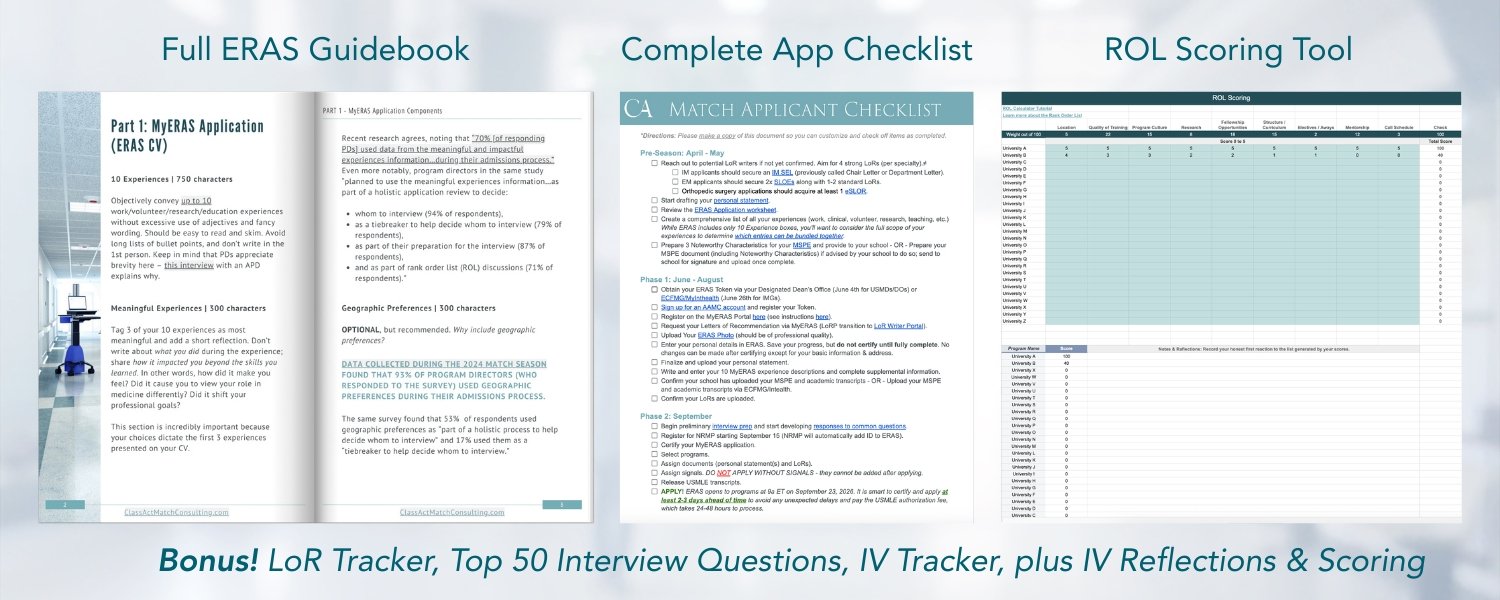
Get Instant Access to Your 2026-27 Match Application Organizer & Resources
Resources Include: Full ERAS/NRMP Match Education E-Book, Complete Application Timeline/Checklist with Key Dates, Letter of Recommendation Tracker, Top 50 Interview Question Bank, IV Reflection & Scoring Worksheets, plus Rank Order List Calculation Tool.

Residency Application Timeline
The residency application timeline and tasks below are designed to spread the workload over a reasonable amount of time so you can develop the strongest application possible without the anxiety-inducing stress of missing a detail or rushing through a document because residency application opening day is looming.
Key dates may change – always verify with official resources.
Key Application Dates 2026:
June 4 – ERAS application opens for USMDs and DOs
June 25 – Tokens available to IMGs
July/August – Prepare ERAS/CAS Application
September 3 – First day to certify & apply to programs
September 15 – NRMP Registration opens; create R3 account
September 23 – ERAS applications available to programs, 9 am ET
Key Application Dates 2027:
January 29 – NRMP Registration Deadline ($50 late fee after)
February 1 – R3 opens for ranking
March 3 – ROL deadline
March 3 – NRMP Registration deadline
March 15 – Start of Match week/SOAP begins
March 19 – Match Day!
Stay prepared! Explore the detailed residency application timeline and checklist below.
April / May
- Download the ERAS Applicant Worksheet and begin gathering information. Make a list of questions about the application and ask a knowledgeable mentor to clarify them.
- Familiarize yourself with this checklist and keep it updated throughout application season.
- Begin requesting Letters of Recommendation (LoRs). Make a list of your letter writers and keep track of requested/uploaded LoRs here.
- Decide what specialty you’ll apply to. If you’re applying to secondary fields, plan to prepare specialty-specific personal statements and LoRs.
- ERAS Photo: Schedule professional photos and get this easy item out of the way now!
- Confirm your school will prepare your MSPE.
- Write your Noteworthy Characteristics and send to your school.
- If preparing your own MSPE, refer to the AAMC guidelines and template and review these recommendations.
June
- Sign up for an AAMC account (you’ll need this to register your Token).
- Obtain your ERAS Token via your Designated Dean’s Office (ECFMG/MyIntealth for IMGs – June 26th for IMGs). The AAMC offers specific instructions for registering on the MyERAS Portal here.
- Upload ERAS Photo.
- Send formal Letter Request Form via MyERAS to LoR authors.
- Begin completing the basic information and demographic sections of the MyERAS Application. Save your application progress, but do not certify your application. After certifying, you cannot add or change anything except for personal/contact information.
- Start researching programs and recording their requirements/preferences. Here’s a simple tracking sheet you can use.
June continued...
- Compile a list of all possible activities to include in your MyERAS Application. Don’t leave anything out, even if the experience feels “small” in your eyes! When selecting experiences for your 10 ERAS CV entries, it’s best to start with the full scope of options. For initial brainstorming, include everything from these categories:
- Work
- Volunteer
- Education/Training
- Military Service
- Research
- Teaching/Mentoring
- Professional Organization
- Brainstorm ideas for your PS and create a rough draft. It may seem early now, but this document is best approached over a period of weeks, not days!
July
- Schedule dedicated writing and revision time to finalize your PS by the end of the month.
- Begin selecting activities from your comprehensive list of experiences. Review these articles for guidance on bundling and writing strategies, and then start drafting descriptions.
- Continue filling in the basic information and demographic sections of MyERAS.
- Follow up on LoRs. Letters may take up to 3 weeks to become available in ERAS after uploading.
- Take Step 2 by 7/29-8/15 as it can take 2-8 weeks for your score to be released.
August
- Continue writing your experience descriptions and select 3 meaningful experiences.
- Write supplemental MyERAS content:
- 3 geographic preferences
- Setting preference
- Impactful experience (if applicable)
- Academic/professional interruptions or extensions (if applicable)
- Hobbies
- Publications, presentations, etc.
- Additional questions section
- Specialty-specific questions (as of 4/2025: anesthesiology, plastic surgery integrated, neurosurgery)
- Follow up on MSPE and transcript if outstanding.
- Ensure all available LoRs are uploaded and confirmed in ERAS; set follow-up reminders for those that aren’t.
- Finalize all MyERAS Application content by the end of August.
Early-Mid September
- Complete a final proofread of your personal statement(s) and upload into ERAS. If uploading multiple versions for specific programs/different specialties, make sure to name each file clearly.
- Review and proofread your entire MyERAS Application. Download in PDF format, print, and mark corrections with a pen. Why? You are more likely to notice errors on paper than on the screen.
- Follow up on any outstanding LoRs.
- Follow up on MSPE (if outstanding).
- Continue program research.
- Finalize how you’ll use allotted signals.
- Register with the NRMP (9/15) and ensure your ID populates in ERAS within 2-3 business days.
Late September
- Confirm MSPE, Transcript, personal statement(s), and LoRs are uploaded/available in ERAS.
- Make any final additions to your MyERAS for recent/current experiences; proofread and save.
- Aim to Certify your MyERAS 1-2 weeks before ERAS opens to programs on 9/23/2026 (9a ET).
- Finalize program research and signal selections.
- In ERAS:
- Select programs.
- Assign signals. (You cannot signal a program or remove a signal after paying for your applications, so make sure your signal selections are correct before applying!)
- Ensure the correct personal statement and LoRs are assigned to each program.
- Verify your Photo, MSPE, and Transcript are assigned to all programs.
- When ready, submit and pay for your applications at least 48 hours prior to ERAS release, as USMLE Transcripts may take 1-2 days to populate once authorized and released.
All applications submitted prior to the ERAS release date/time will contain the same timestamp. Applying earlier in September is not an advantage.
Note: IMGs should incorporate USMLE exams and Pathway approval/ECFMG certification milestones as needed from April – September.
Do you need assistance planning your 2026-27 ERAS Application strategy?
Learn more about Class Act Essential Consulting: CV/PS & Interview Prep Packages.